Milestones from your goals
Write your goals and a brief in your own words. The Planner turns them into milestones, each with a plain “done when”. Edit anything.

Introducing Runesmith
Open source. Any model: free, paid or on your own servers. Your code, your models, your digital sovereignty.

01The film
Lars Horpestad introduces Runesmith: what it does, how it works with free, paid and local models, and where to start.
The film plays from YouTube, and only after you press play: until then this page sends nothing to YouTube. Watch it on YouTube.
Hi, my name is Lars Horpestad. I'm the CEO at AI ThinkLab. With support of Innovation Norway, we are pleased to announce that we today are releasing our new model named Runesmith.
Runesmith is a non-traditional type of model that uses various sources of inference in order to build on a code basis, new or existing, improve on these, and operate entire digital systems.
It has been built together with an extensive paper named Beyond the Model that we are also releasing together with the open source project named Runesmith.
In that paper, we document how Runesmith can build, improve, and operate entire digital systems. We also document how it can improve on its own digital system.
So it is a nudge in the direction of RSI, or recursive self-improvement. It does take the inference away from the model, which is a little bit in the times these days, as there are so many different sources for inference,
both free from sources like Google AI Studio or NVIDIA, to more expensive such as Anthropic or OpenAI's models.
Many companies and institutions want to use models locally, on their own servers, in their own houses, and we have set this system up such that you can use APIs from, be that your own Ollama project or elsewhere.
Yes. So together with the model, which is open source, you can download it. We can't wait to see what you build.
There is also a guide, an extensive key by key guide that shows you how to use Runesmith.
And if you really want to get a head start using this model and building with it, we also have an extensive guide available on Amazon with a link below also for that.
Thank you for your time, and have a good day.
02Get Runesmith
Runesmith is a non-traditional model: it has no weights of its own. It is a system that wraps whichever model you have and lets that model build software.
Open the repository on GitHub and choose Code, then Download ZIP, and unzip it. Or clone the repository with Git. You need Python 3.11 or newer and a web browser; nothing else is installed, because Runesmith uses only Python’s standard library.
Runesmith Studio runs on your own computer and opens in your browser, through a private link.
Double-clickRunesmith.cmd
In Terminal, in the Runesmith folder:sh Runesmith.command
In a terminal, in the Runesmith folder:sh runesmith.sh
Open Thinking power and add a model: a free key from Google AI Studio or NVIDIA, a paid one from Anthropic or OpenAI, a model on your own computer, or just a chat window you copy and paste into. The free inference guide walks through each, starting with the free ones.
Write a goal, draft a plan, and build it milestone by milestone. You read every draft before it touches your files. The guide goes from the first start to a finished project.
03What it does
Around the model you already have, Runesmith plans the work, has the model write it, and checks every step.
Write your goals and a brief in your own words. The Planner turns them into milestones, each with a plain “done when”. Edit anything.
A model writes the code and you read the draft. Nothing is written to your files until you apply it, or until you allow automatic apply for checked builds in folders you name. Every write can be undone.
Acceptance checks are written in plain sentences, and you approve them before they count. Each draft is tried against them on a throwaway copy of your project.
Runesmith keeps what it learns in records it owns, on your computer, not inside any one model. Use a free model, a paid one, or one you run yourself.
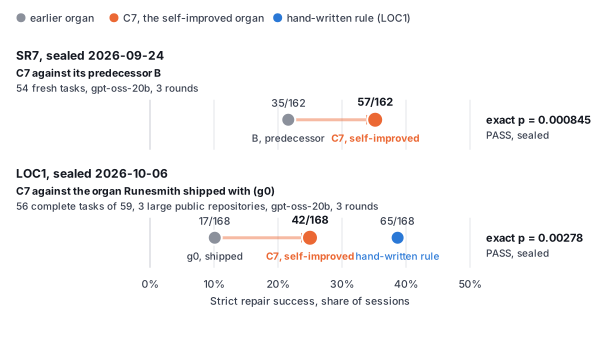
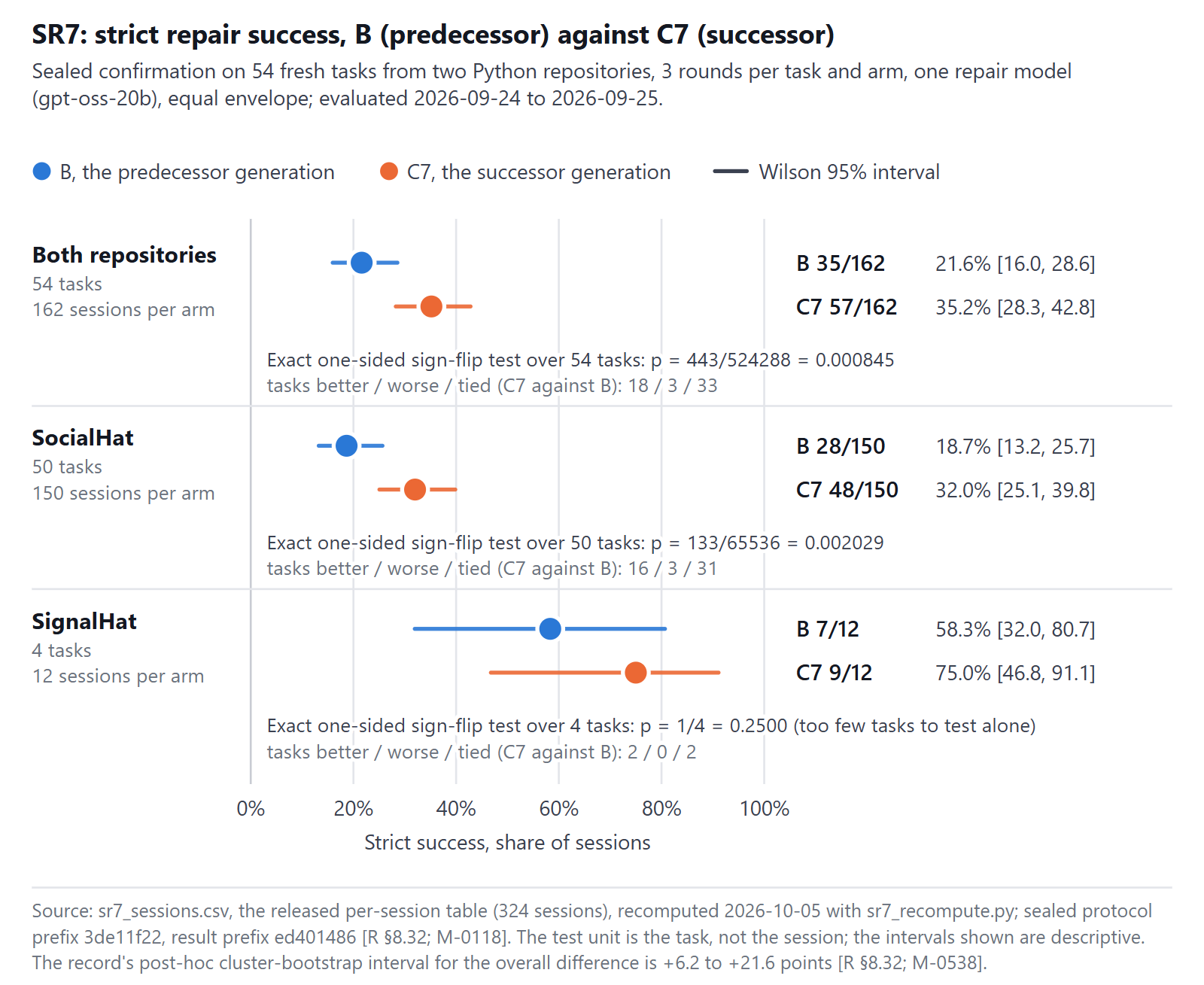
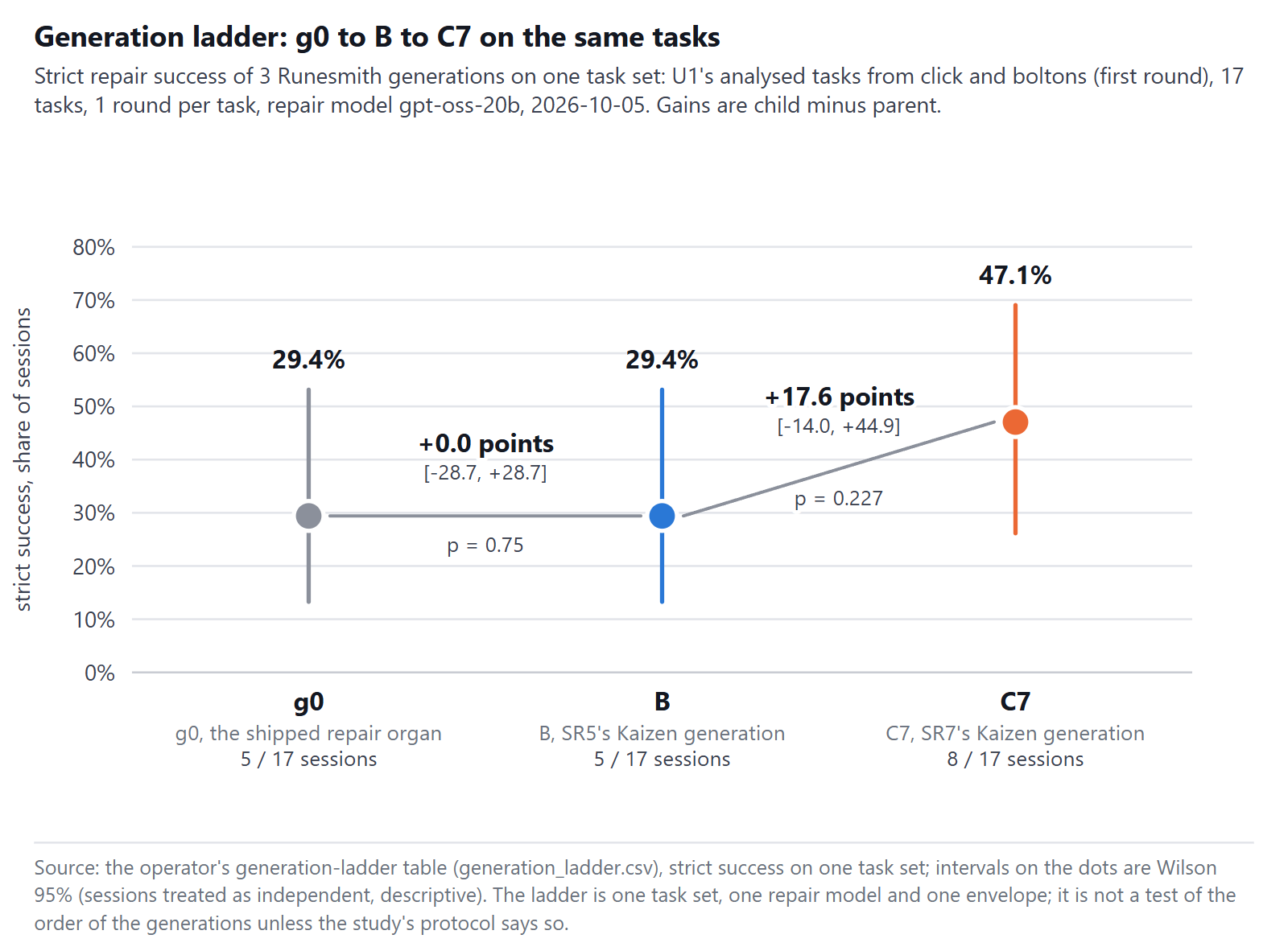
Runesmith can also work on its own system. It reads its own records, finds where it struggles, asks a model to rewrite the part responsible, and keeps the change only if it does better on work its author never saw. In two sealed tests, with the rules locked before any result existed, a change made this way solved more tasks than the version before it (57 against 35) and then more than the repair step Runesmith shipped with (42 against 17). We call it a nudge towards recursive self-improvement, and we publish every result, including the one where a careful hand-written rule did better still. In the Studio, self-improvement stays off until you switch it on.
04The record
Every figure comes from the paper’s record or the project’s files. Studies that did not work are counted too.
From the research program’s first file, on 3 September 2026. Runesmith’s own repository begins later, on 25 September.
The program has run 23, and the nulls and the failures count with the passes. Most did not show their effect. The first sealed self-improvement test still passes after correcting for all 23; the second, run on 6 October, also passed, and in it a hand-written rule did better than the self-improved step.
Every session outcome of the first sealed self-improvement test, released with the script that recomputes its exact test. The second test’s sessions, seals and Bitcoin timestamp proofs are released too.
Each run start to finish by an AI operator, with every finding recorded. This is not a user study.
In the released repository’s test suite.
Every number here is sealed, published and recomputable from the released data. The paper states exactly what each test measured, including that the second test was against Runesmith's own shipped repair step, where a careful hand-written rule did better still, and that no study yet compares a model alone with the same model inside Runesmith.
05Built with Runesmith
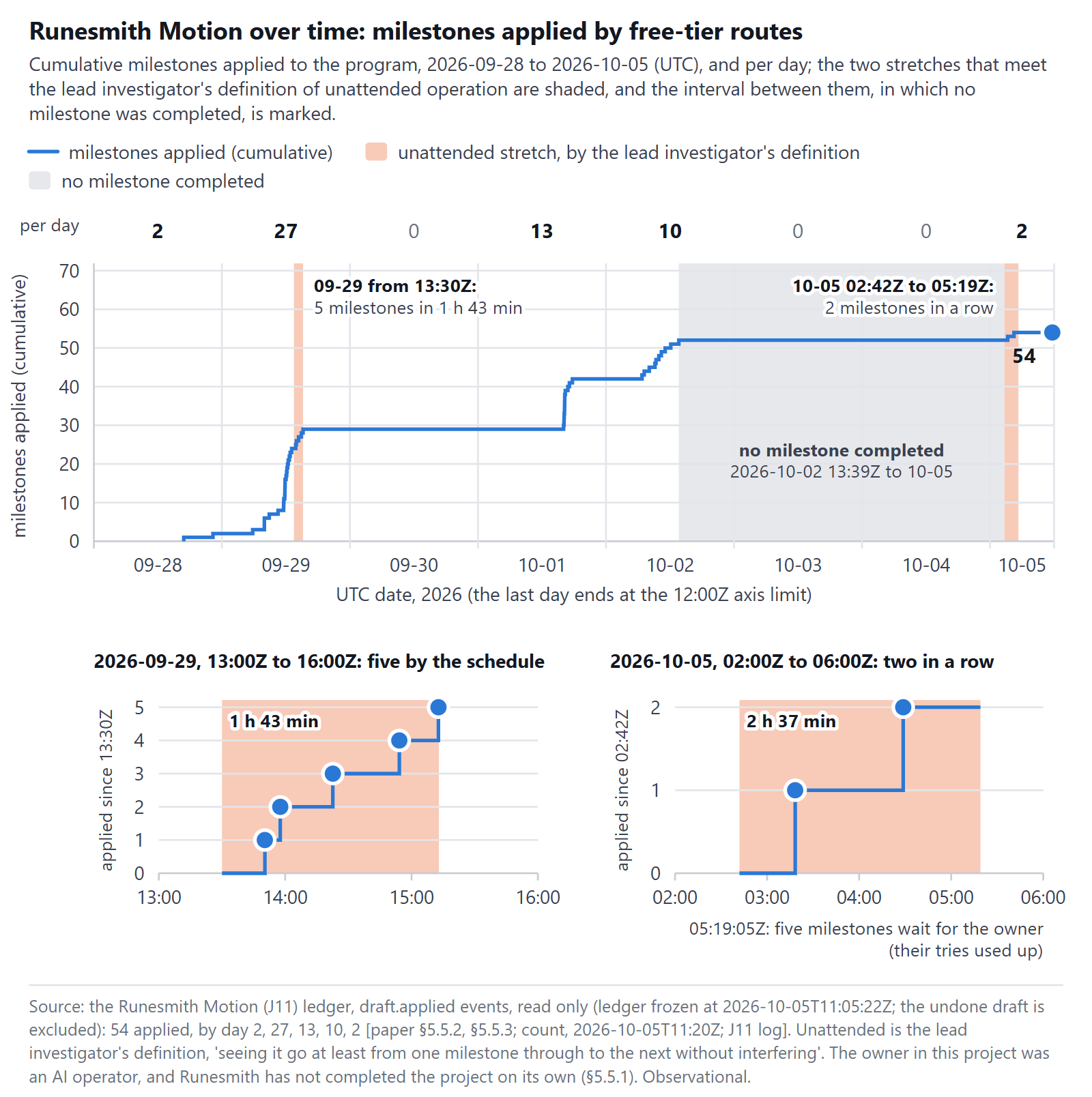
Runesmith Motion is a video program that Runesmith built under an AI operator’s direction, using free inference.
In practice, free-tier models were the last author of every applied change, through Runesmith, milestone by milestone. A human-directed AI operator planned and audited the work, and stepped in when it stalled. The paper says plainly where it fell short.
06The paper
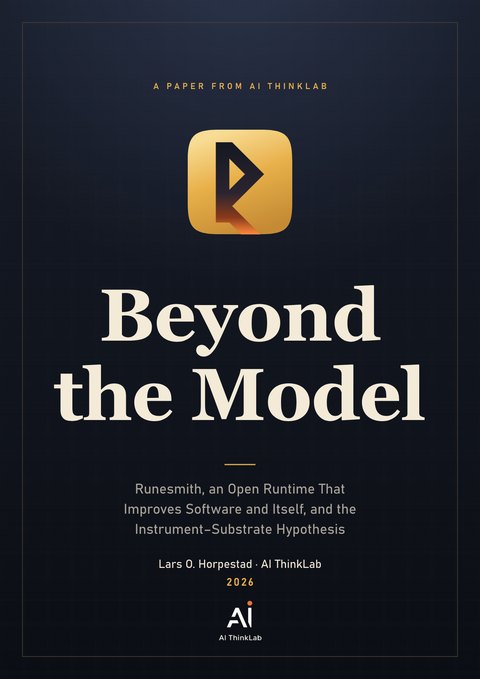
Beyond the Model: Runesmith, an Open Runtime That Improves Software and Itself, and the Instrument–Substrate Hypothesis
Lars O. Horpestad, AI ThinkLab. Preprint, not peer reviewed. DOI 10.5281/zenodo.23196763.
The paper asks where an AI agent’s competence lives: in the model it calls, or in tested, inspectable state that the system keeps for itself and can still use when the model is replaced. It presents Runesmith as the runtime built to test that idea, shows it improving its own code under two sealed tests, and reports every sealed result, including the ones that did not go our way. The paper is 17 pages. The technical report, 90 pages, gives the full method, the source of every number and the complete negative record.
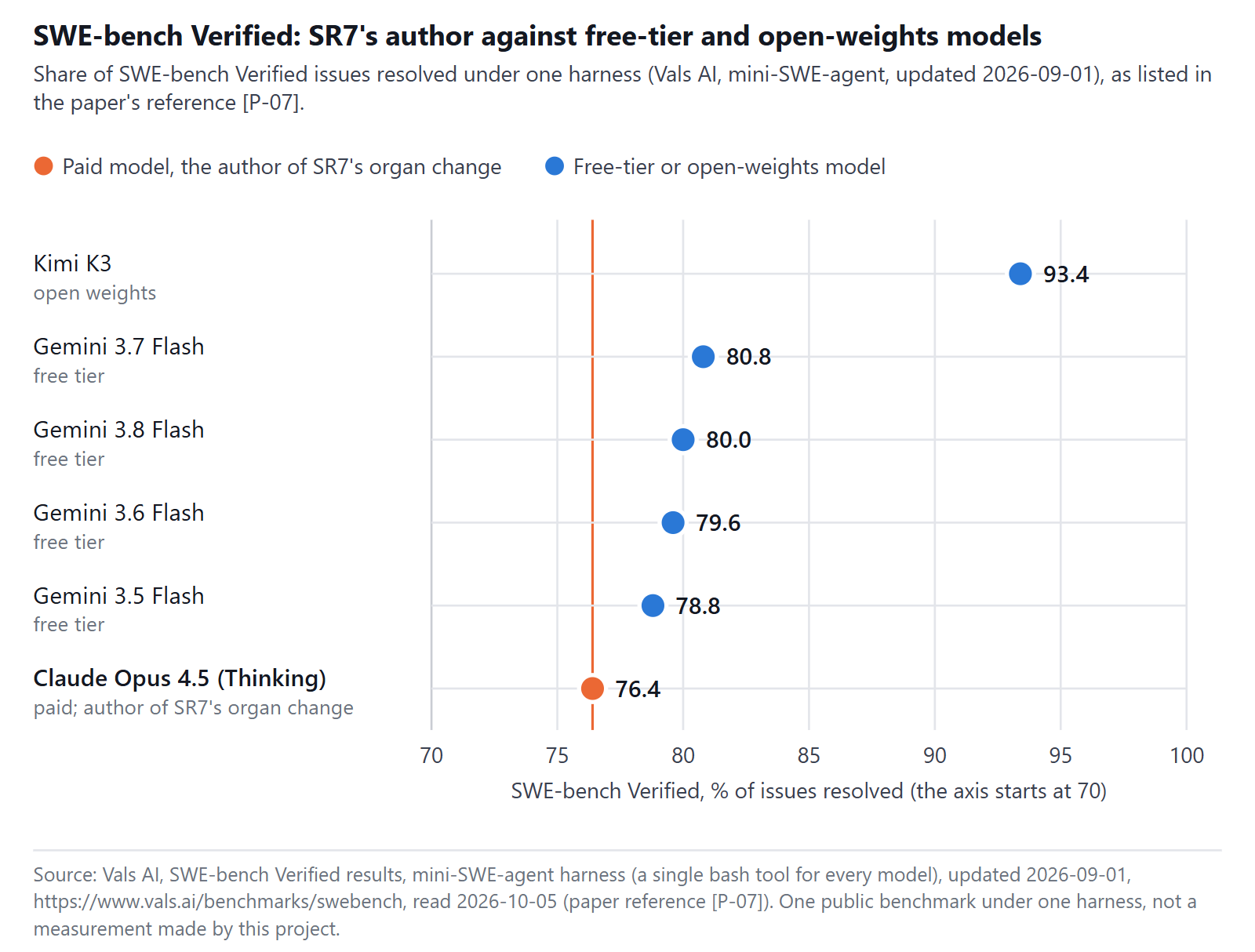
Four of the paper’s figures and one from the technical report (the Runesmith Motion chart), each with the numbers it shows. Full captions and sources are in the two documents: the paper (PDF) and the technical report (PDF). Select a graph to open it full size.
In the figures, g0 is the shipped repair step, B the earlier generation, C7 the newer one, and SR7 and LOC1 the names of the two sealed tests.
07Learn Runesmith
Every switch in one card, step-by-step recipes, what each message means and what to do about it. Free, on this site, and as a PDF.
Lars Horpestad’s own guide to building with Runesmith, for a head start. Available on Amazon.
08Coming soon
Release 1 keeps everything Runesmith learns on your own computer. Nothing is shared between users, and nothing is uploaded. What follows is a plan, and it has open design questions (privacy, abuse, fair accounting), not a feature you can switch on today.
Improvements that Runesmith wrote for itself could be offered between people through the open-source repository, only if you choose to take part. Each upgrade would have to pass the same evidence checks on the receiving machine before it could be used.
You would choose how much of your own inference goes into improving Runesmith itself. A scoreboard and legends would recognise those who give the most, and everyone who opts in would receive the upgrades that this shared effort earned.
The mission
Imagine being a kid with just a laptop and a Google account, and getting this gift.
AI ThinkLabMakes and releases Runesmith.

Empowered by VeristriaHosting and security partner.

With support from Innovation Norway
Contact: contact@aithinklab.com